

Entrepreneurship training has become a standard instrument in development policy and SME support worldwide. Yet for many years, evidence on its effectiveness remained mixed. Traditional business trainings—focused on accounting, marketing, and business planning—often improved knowledge, but did not consistently translate into higher profits. A different approach has emerged from psychological research: Personal Initiative (PI) training (Campos et al, 2017).
What Is Personal Initiative in Entrepreneurship?
Personal Initiative is defined as self-starting, proactive, and persistent behavior directed toward achieving goals (Fay & Frese, 2001; Frese et al., 1997). In entrepreneurship, this means acting without being told, anticipating future challenges and opportunities, and persisting despite obstacles.
PI consists of three interrelated behavioral dimensions:
Key Traits of Personal Initiative
Personal initiative in entrepreneurship has three interrelated facets that together form a proactive approach:

Self-starting. Entrepreneurs actively pursue opportunities rather than waiting for instructions or perfect conditions. For example, instead of sticking to prescribed tasks, a self-starting entrepreneur seeks out new ideas and opportunities on their own.

Future-oriented. They anticipate risks, prepare alternatives (Plan B/C), and strategically shape their environment. PI entrepreneurs develop long-term business plans and contingencies (bootstrapping resources and preparing Plan B/C) rather than relying solely on existing methods.

Persistence.
They overcome setbacks and adapt instead of withdrawing when difficulties arise. When setbacks occur, a PI-driven entrepreneur doesn’t give up – they adapt, seek solutions, and keep moving forward.
Rather than focusing primarily on knowledge acquisition, PI training targets these behavioral patterns. The underlying theory is clear: sustainable entrepreneurial success depends not only on what entrepreneurs know, but on how they act.
Together, these traits ensure that learning and ideas immediately translate into effective action. They contrast with a passive mindset, where one might only follow instructions or give up when faced with difficulties. Research shows that PI is closely linked to positive outcomes: it “is consistently linked to higher work performance and innovativeness”, and it fosters entrepreneurial success by driving idea generation and innovation. In other words, proactive entrepreneurs tend to outperform and out-innovate their peers.
The Scientific Evidence: Why PI Training Works
The strongest evidence comes from randomized controlled trials.
In a first implementation in Uganda, PI training increased personal initiative behaviors compared to a control group. Additionally, this increase of personal initiative was responsible for the increase in business success for training participants (Glaub et al., 2014)
In a landmark study in Togo, Campos et al. (2017) compared traditional business training to Personal Initiative training. The results were striking: entrepreneurs who received PI training increased profits by approximately 30%, compared to about 11% in the traditional training group. Even more notable, women entrepreneurs who participated in PI training increased profits by nearly 40%, while women in the traditional training group saw only marginal gains (Campos et al., 2017).
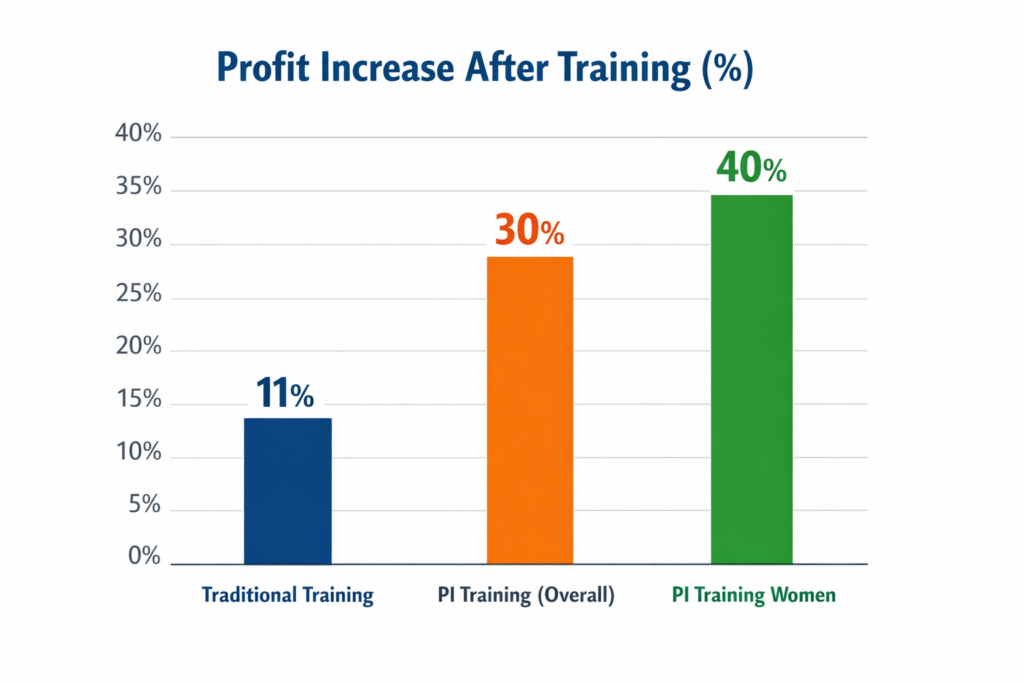
Importantly, PI-trained entrepreneurs did not simply improve bookkeeping or marketing in mechanical ways. Instead, they introduced more new products, diversified offerings, and invested more in their businesses. The training fundamentally changed how they approached opportunities and setbacks.
Similar findings emerged from impact evaluations in Ethiopia. A randomized evaluation of the Digital Opportunity Trust (DOT) entrepreneurship program found that trained female entrepreneurs experienced approximately 30% higher profits one year after training (Alibhai et al., 2016). Interestingly, improvements in formal business practices were limited. Instead, the strongest measurable effects were increases in self-efficacy, locus of control, and personal initiative.
Earlier research within the STEP (Student Training for Entrepreneurial Promotion) project also demonstrated that entrepreneurship grounded in proactive behavior leads to higher business creation and employment outcomes compared to control groups
Across studies, a consistent pattern emerges:
Personal Initiative training produces stronger and more durable economic outcomes than traditional business instruction.
What Does PI Training Actually Change?
From a practitioner perspective, the key insight is this: PI training does not merely add knowledge: it changes behavior.
Research shows that participants:
- Take more initiative in opportunity recognition
- Actively shape their business environment
- Invest more strategically
- Recover faster from setbacks
- Demonstrate higher confidence and action orientation

Entrepreneurs (in Togo)
The behavioral shift appears to be the mechanism through which profits increase. As the World Bank evaluation notes, training-induced changes in mindset—not simply technical skills—are likely responsible for improved business outcomes (Alibha et al, 2016).
This explains why PI training remains effective even in environments characterized by limited access to capital, unstable markets, or institutional constraints. When entrepreneurs cannot control structural conditions, proactive behavior becomes even more decisive.
Why This Matters for Practitioners?
For policymakers, donors, and implementers, the implications are significant:
- Traditional curriculum-heavy business training may not be sufficient.
- Behavioral change interventions can produce higher returns on investment.
- Supporting entrepreneurs requires building action competence, not just technical knowledge.
PI training is particularly relevant for women, youth, and entrepreneurs operating in fragile or low-resource contexts. Evidence consistently shows stronger relative gains for women in PI-based interventions (Campos et al., 2016).
move-eti: The Most Experienced PI Provider
move-eti is the leading organization in the adaptation and large-scale implementation of Personal Initiative training worldwide. Over the past years, PI training has been implemented in multiple countries across Africa, Europe, and beyond, often in partnership with the World Bank, GIZ, and national governments
What distinguishes move-eti’s approach is:
- Extensive implementation experience across projects of different scale and funding partners, ranging from collaborations with small NGOs to large-scale programs funded by international institutions reaching tens of thousands of beneficiaries.
- A global network of certified master trainers and experts, enabling localized high-quality implementation at scale.
- Deep integration of research and practice, with team members and collaborators directly involved in the scientific development and evaluation of PI training.
- A diverse team of experienced female experts, contributing to gender-responsive program design and strong outcomes for women entrepreneurs.
- Multilingual implementation capacity, with PI training delivered in numerous languages through a large network of trainers and master trainers.
This combination of scientific expertise, global reach, and practical implementation capacity allows move-eti to translate cutting-edge research into large-scale programs that deliver measurable economic impact.
Conclusion
Personal Initiative is not a soft skill add-on. It is a scientifically validated behavioral framework that consistently outperforms traditional business training in increasing profits and entrepreneurial resilience.
For practitioners seeking measurable impact, the message from over a decade of research is clear:
Teach entrepreneurs how to act proactively—and business performance follows.
Sources
Alibhai, S., Buehren, N., & Papineni, S. (2016). From learning to earning: An impact evaluation of the Digital Opportunity Trust (DOT) entrepreneurship training. World Bank Gender Innovation Lab. Available at:https://doi.org/10.1596/25450
Bischoff, K.M., Gielnik, M.M. and Frese, M. (2014) “Entrepreneurship training in developing countries,” Industrial and Organizational Psychology Help the Vulnerable: Serving the Underserved, pp. 92–119.
Campos, F. et al. (2017) “Teaching personal initiative beats traditional training in boosting small business in West Africa,” Science, 357(6357), pp. 1287–1290. Available at: https://doi.org/10.1126/science.aan5329.
Fay, D. and Frese, M. (2001) “The Concept of Personal Initiative: An Overview of Validity Studies,” Human Performance, 14(1), pp. 97–124. Available at: https://doi.org/10.1207/S15327043HUP1401_06.
Frese, M. et al. (1997) “The concept of personal initiative: Operationalization, reliability and validity in two German samples,” Journal of Occupational and Organizational Psychology, 70(2), pp. 139–161. Available at: https://doi.org/10.1111/j.2044-8325.1997.tb00639.x.
Gielnik, M.M. et al. (2015) “Action and action-regulation in entrepreneurship: Evaluating a student training for promoting entrepreneurship,” Academy of Management Learning and Education, 14(1), pp. 69–94. Available at: https://doi.org/10.5465/amle.2012.0107.
Glaub, M.E. et al. (2014) “Increasing personal initiative in small business managers or owners leads to entrepreneurial success: A theory-based controlled randomized field intervention for evidence-based management,” Academy of Management Learning and Education, 13(3), pp. 354–379. Available at: https://doi.org/10.5465/amle.2013.0234.